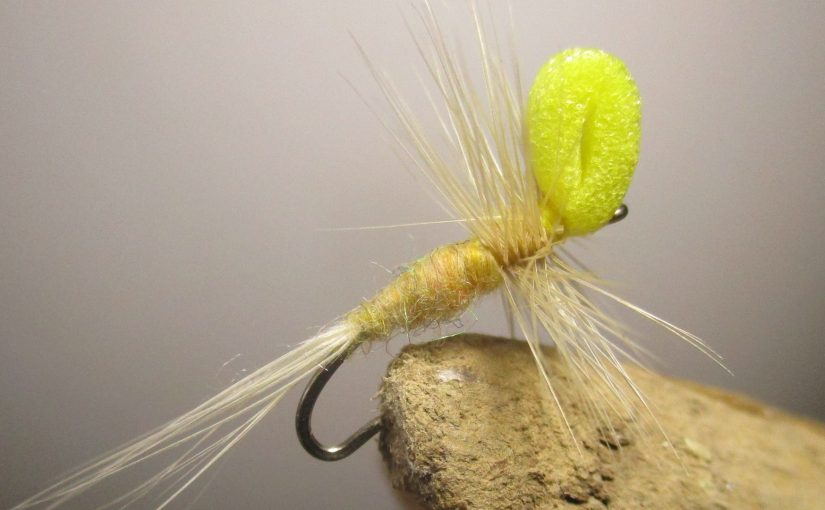
This foam-headed generic mayfly has brought me a lot of success this past year. Tied here as a sulphur, it can easily be turned into any mayfly you have a need to imitate. (Or a midge if tied small enough.)
- Hook: #14-20, curved shank, 3x long
- Thread: Any color to match the insect
- Tail: Any color hackle fibers
- Body: Any color dubbing
- Hackle: Any color dry fly
- Post: 2mm foam, any light color
I came up with this one last fall. I didn’t really invent it as I’m sure I saw a picture of it somewhere and thought, I can use this fly. So, how I tied it originally was small, in sizes 18s and 20s on a little curved shank, 3X long hook. But I was tying it as a midge and in standard natural colors– just a tail, body, and hackle. But I added one element to make it more fishable. A small foam loop, posted upright just in front of the hackle. And the fly did really well for me on a Savage River through December and into mid January.
Now the one I tied for the channel, I changed up a little bit. I made it bigger and turned it into a generic mayfly. In this case a sulfur, but in a bigger size as a generic mayfly, you could really make this pattern anything you want. It could easily be a March Brown, a PMD or a Blue Wing Olive. Just change the colors and the sizes accordingly.
And I typically fish this pattern in moderate to faster moving water. The fly is going to sit down on the surface film. The hackle, if you don’t put floatant on it, will keep it barely on the surface but the foam “hat” will stay just out of the water. Now one cool thing about this is that after fishing it through a faster riffle or run, it might be a few inches under the surface, but with the foam, it’s going to slowly come back up to the surface. That’s when it looks like an emerging insect or maybe just a drowned adult. And I’ve had fish take it both as it’s drifting slowly on the surface, and when it’s sunken a few inches.